
Gesture Wristbands vs Camera Control: A Field Guide
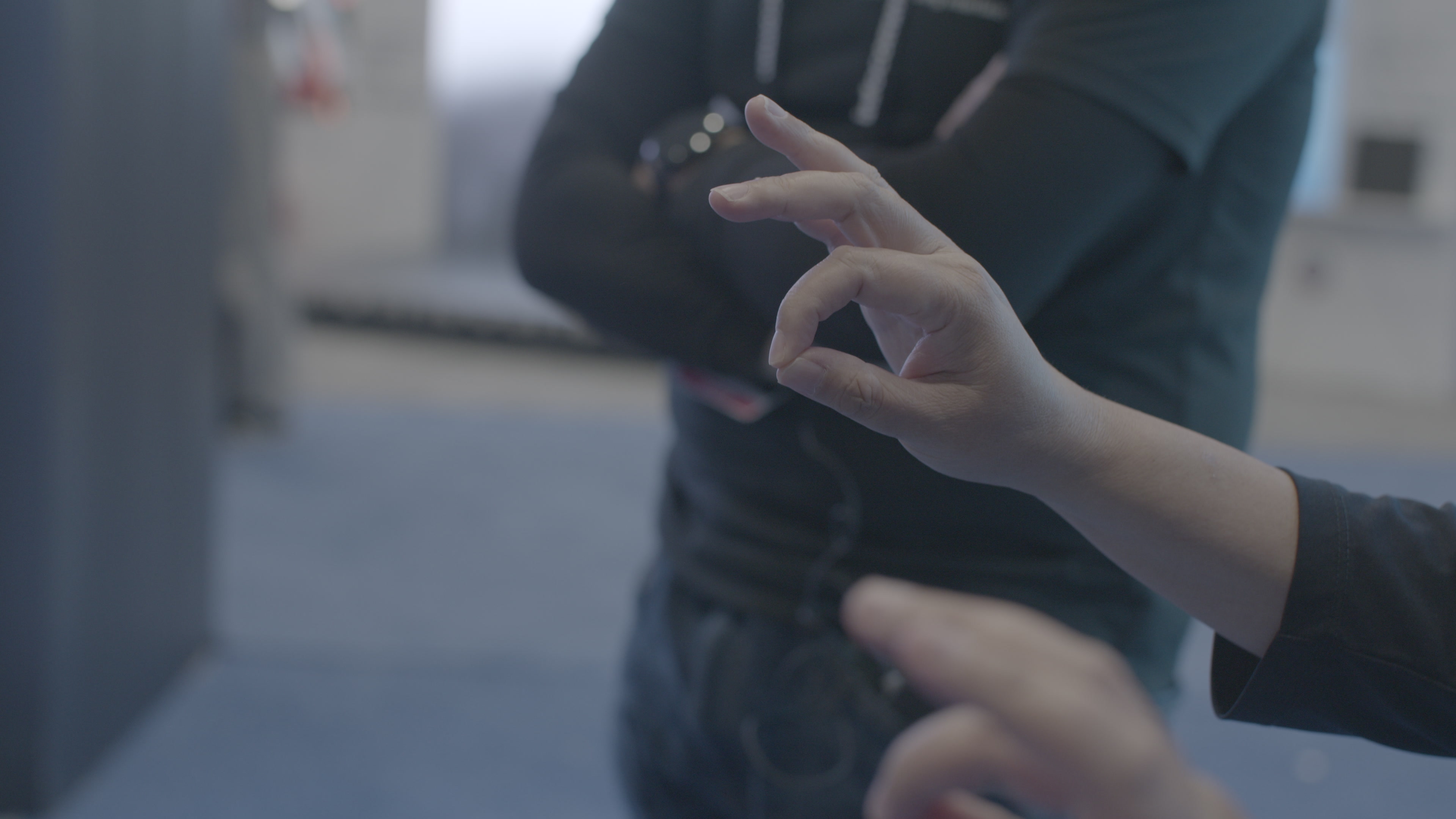
Here is the short answer. Wearables and cameras solve different halves of the gesture problem. A wristband travels with one person and works with no line of sight, in the dark, in silence, on the move. A camera serves a place: any person who walks up to the screen can control it with nothing on their body. If you are equipping an individual, especially alongside smart glasses, the wearable crowd has strong entries. If you are equipping a screen, a room, a kiosk, or a product line, camera-based gesture control like AirTouch wins on economics, hygiene, and walk-up usability, and this article will be honest about both halves.
Which gesture wristbands exist in 2026?
The category is crowded and moving fast, so treat details as reported at the time of writing. Meta's Neural Band, an sEMG wristband that reads motor nerve signals, ships bundled with Ray-Ban Display glasses at around $799 and is locked to Meta's ecosystem. Pison built its name on nerve-signal wristbands for demanding users, including military programs, and has expanded toward neurocognitive wellness products and READY, an assistive controller. Mudra, from Wearable Devices, sells neural input bands for Apple Watch and a cross-platform Mudra Link at around $199. Doublepoint took a software route, turning ordinary smartwatches into gesture controllers, and was acquired by Oura in early 2026. TapXR straps a tap-typing sensor to the wrist. At the far end, HaptX, now part of 1HMX, makes force-feedback gloves for enterprise VR training at around $5,495 a pair plus a backpack air compressor and a subscription. These are real products from serious teams, and several are excellent at what they do.
What is camera-based gesture control?
AirTouch is patented gesture control and hand tracking software from Neural Lab. It reads hands through any standard RGB camera and maps gestures to mouse, keyboard, and touch input at the operating system level, so every existing app becomes a touchless interface with zero integration and users wear nothing at all. Through our partnership with Orbbec, it also takes advantage of 3D depth sensing and IR cameras, which extends camera control into dark rooms and precision spatial work. Windows, Linux, and Android today, macOS on the way, roughly 50ms latency, and patented intent detection that keeps a shared screen obeying the person who means to control it.
How do wearables and camera control differ?
Per-user versus per-screen economics. A wearable is bought, sized, charged, paired, and often calibrated for every user. A camera install serves every user of that screen, including ones who have never seen it before. Multiply each model by a lobby, a hospital wing, or a product line and the totals diverge quickly.
Walk-up and shared use. Sharing a wristband between people is awkward at best and a hygiene problem at worst. A camera has nothing to hand over.
Sterile and soiled environments. This is the sharpest divide. Skin-contact sensors are hard to reconcile with surgical gloves and scrub protocols, and a shared band is one more surface to sterilize. AirTouch is trained for gloved hands including surgical glove colors, works through protective glass, and is deployed in clinical settings today with nothing worn and nothing touched.
App compatibility. Most bands pair with a specific ecosystem, a specific watch, or specific glasses. AirTouch speaks OS-level input, so it drives whatever software the machine already runs.
Sensor range and choice. A band works wherever your arm is, which is a real advantage in the field. For screens, AirTouch range is limited by the camera, not the software; deployments run at 20 feet and beyond, and the Orbbec partnership adds 3D depth and IR camera options.
Feedback and discretion. Wearables can vibrate back at you and can register a micro-gesture from a hand resting at your side, silently and on the move. Cameras need line of sight, though IR-capable Orbbec cameras remove the darkness half of that limit. The rest of that tradeoff is physics, and it is the honest heart of this comparison.
When does a wearable win?
Personal, mobile, eyes-busy computing. If the user is walking a warehouse, riding a bike, or wearing smart glasses, a band on their wrist beats a camera that is not there. Assistive use is another bright spot: for users with limited mobility, products like Pison's READY and Mudra's bands open input channels a camera cannot. And for VR training where trainees must feel resistance, force-feedback gloves like HaptX's are the only technology on this page that pushes back. For a single user in motion, the wearable category is not a compromise; it is the right answer.
When does camera control win?
Every shared screen. Kiosks, signage, conference rooms, showrooms, clinical workstations, and OEM products serve many people who arrive with nothing provisioned, and per-user hardware breaks exactly there. Camera-based hand tracking needs no sizing, charging, pairing, or sanitizing between users, costs the same whether five or five thousand people use the screen, and in sterile settings it is often the only workable option. AirTouch adds the part plain tracking misses: patented intent detection, so the screen follows the person deliberately controlling it and ignores the crowd.
Which should you choose?
Scenario | Best fit | Why |
|---|---|---|
Smart glasses and XR headset companion | Wristband (Meta Neural Band and peers) | Discreet, eyes-free input that travels with the wearer |
Field and warehouse work on the move | Wristband | No line of sight needed, works in motion anywhere |
Accessibility for an individual user | Wristband (READY, Mudra) | Personal calibration is a feature, not a cost |
VR training with force feedback | HaptX gloves | The only option here that physically pushes back |
Kiosks, signage, and public displays | AirTouch | Walk-up use with zero hardware per user, crowd-proof intent detection |
Conference rooms and offices | AirTouch | One install serves everyone who enters the room |
Medical and sterile environments | AirTouch | Nothing worn, nothing shared, gloved hands and glass handled |
Dark or low-light rooms | AirTouch + Orbbec | IR-capable cameras through the Orbbec partnership |
OEM screens and devices | AirTouch | No per-user accessory on the bill of materials |
Equipping a shared screen, a clinical space, or a product line? We will test AirTouch against your exact environment: book a demo. Or prove the walk-up experience yourself: start a free trial on the camera you already own.
Related: gesture control and hand tracking software, what is a touchless interface, medical solutions, and AirTouch vs Ultraleap.
© 2026 Neural Lab, Inc.
Designed and built in Sunnyvale, CA