
Immersive 3D Without the Headset
The VR headset made a promise it keeps struggling to fulfill: step inside the content, reach out, and touch it. On paper, wonderful. In a hospital, a museum, or a showroom, the headset is the thing that gets in the way.
Ask the people who actually have to use them. A headset traps the experience on one person's face, so nobody else in the room can share it. It has to be donned, doffed, and disinfected between users, which no sterile or public workflow has time for. It disorients some people within minutes. And it's a cost per head that scales badly the moment you need more than one.
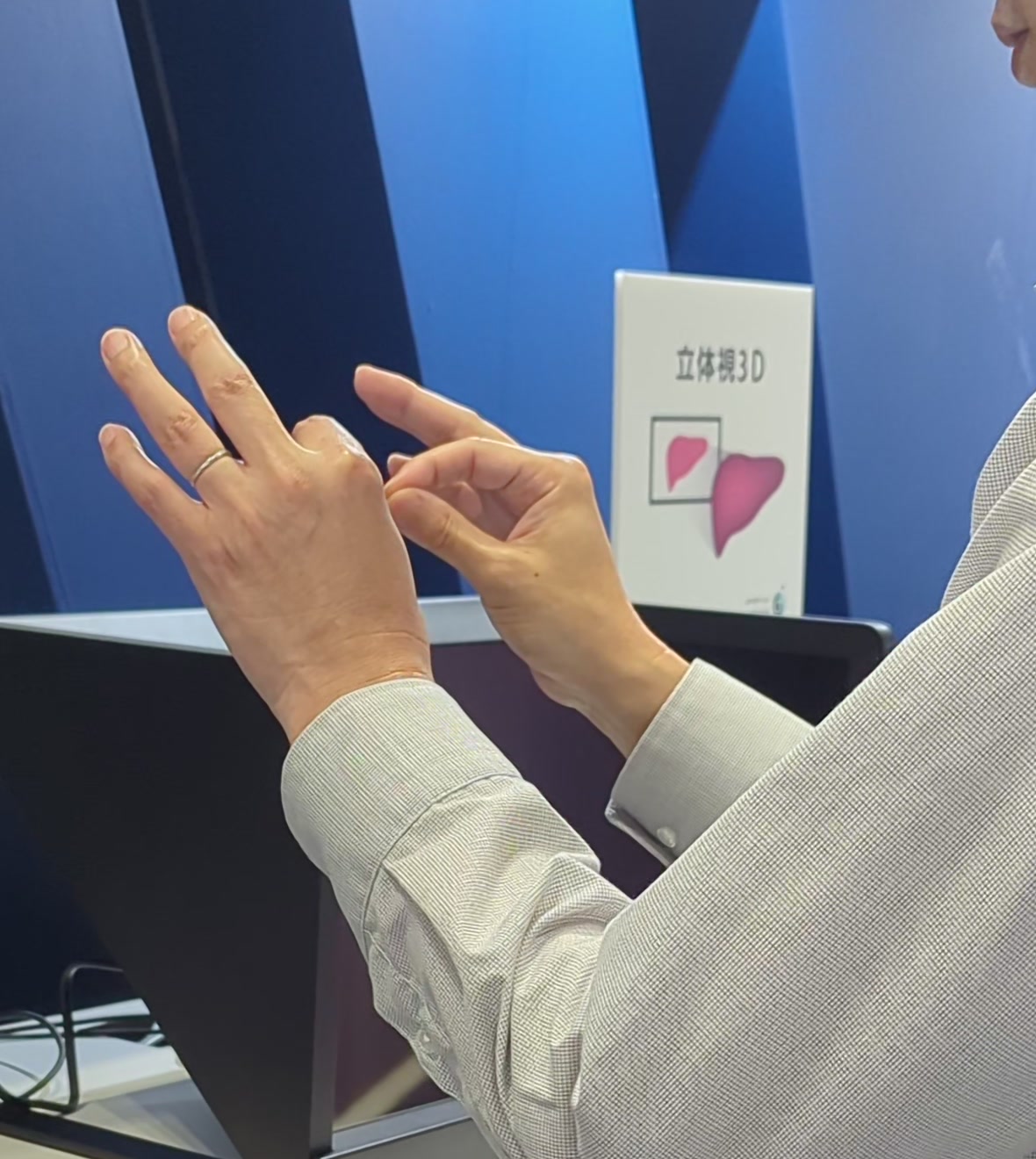
There's another way to get the reach-out-and-touch part without any of that. AirTouch adds gesture control to glasses-free 3D and mixed-reality displays, so people manipulate spatial content with their bare hands while everyone in the room sees the same thing on the same screen. Nothing to wear. Nothing to pass around. Nothing to sanitize between users.
What this unlocks
Shared, not solo. A team can gather around a 3D display and collaborate, instead of taking turns inside a headset.
Touchless and sterile-friendly. In environments where donning and doffing is a non-starter, there's nothing to don in the first place.
Standard camera in, hands out. A normal camera watches the user; AirTouch's patented hand tracking turns their movement into control of the 3D scene.
Can you get Apple Vision Pro-like gestures without a headset?
The pinch, point, and swipe interaction that Apple Vision Pro-style headsets popularized works on an ordinary screen when a camera does the sensing instead of the headset. AirTouch reads those gestures through any standard RGB camera and turns them into input for whatever is on the display, so a monitor, a video wall, or a glasses-free 3D display becomes the spatial interface, and everyone in the room sees the same thing. The full comparison is in Vision Pro-like gestures on any screen.
Which displays work for headset-free 3D?
Any display the computer can drive. Glasses-free 3D displays such as the Sony Spatial Reality Display are the natural fit for volumetric content, but the same gesture layer works on a flat monitor, a projector, or an LED wall, because AirTouch controls the application rather than the screen. Nothing changes in the 3D software itself; it receives standard mouse, keyboard, or touch input.
Why the hands, specifically
Our whole thesis is that the interface you were born with beats the one you have to strap on. Gesture control lets a radiologist rotate an anatomy model, a curator drive an exhibit, or a designer walk a client through a product, all by hand, all without the headset tax.
If your 3D content currently lives behind a headset, it doesn't have to. See it running on a glasses-free display like the Sony Spatial Reality Display. Start a free trial.
Related: gesture control and hand tracking software, immersive and displays, and AirTouch on the Sony SRD.
© 2026 Neural Lab, Inc.
Designed and built in Sunnyvale, CA